Enter your email to receive alerts for this author.
Sign in or create an account to better manage your email preferences.
Are you sure you want to unsubscribe from email alerts for Luke Winkie?
On a recent Friday night, with the early-summer air whetting the sky, I drove with a friend out of New York City, across the Verrazzano Bridge, and into New Jersey, where we took our seats in the imperial 1,850-capacity State Theatre in New Brunswick. Seated next to us was a woman in her early 70s who had not yet realized that she was about to see the Beach Boys. She thought she had purchased tickets for an especially expensive cover band, because the idea that the desiccated remnants of the group could still be touring—62 years after the release of “Fun, Fun, Fun”—seemed frankly impossible. No, I replied to her. Not quite.
In a matter of minutes, she would, indeed, bear witness to what will certainly be one of the last-ever shows performed by America’s greatest pop group. I told her that the Beach Boys would blitz through the car songs and the surf songs; that they would detour into the winsome and psychedelic Pet Sounds; that they would play “Kokomo”—they always play “Kokomo”—and they would do all of this without the presence of Carl, Dennis, or Brian Wilson, who are dead, or guitarist Al Jardine, who has been bitterly estranged from the group for ages, or bassist Bruce Johnston, who retired from the band in March after a seven-decade run.
Left behind is only one original member: The frequently embattled 85-year-old Mike Love. He has been touring with a fugazi version of the Beach Boys constantly since the late 1990s, replicating some vestigial approximation of the band’s golden years, a process that has naturally become more strained over time. Nevertheless, Love has made it his life’s work to keep the Beach Boys alive, even if—as I’m learning from my conversation with the woman—everyone in America already thinks they’re long gone.
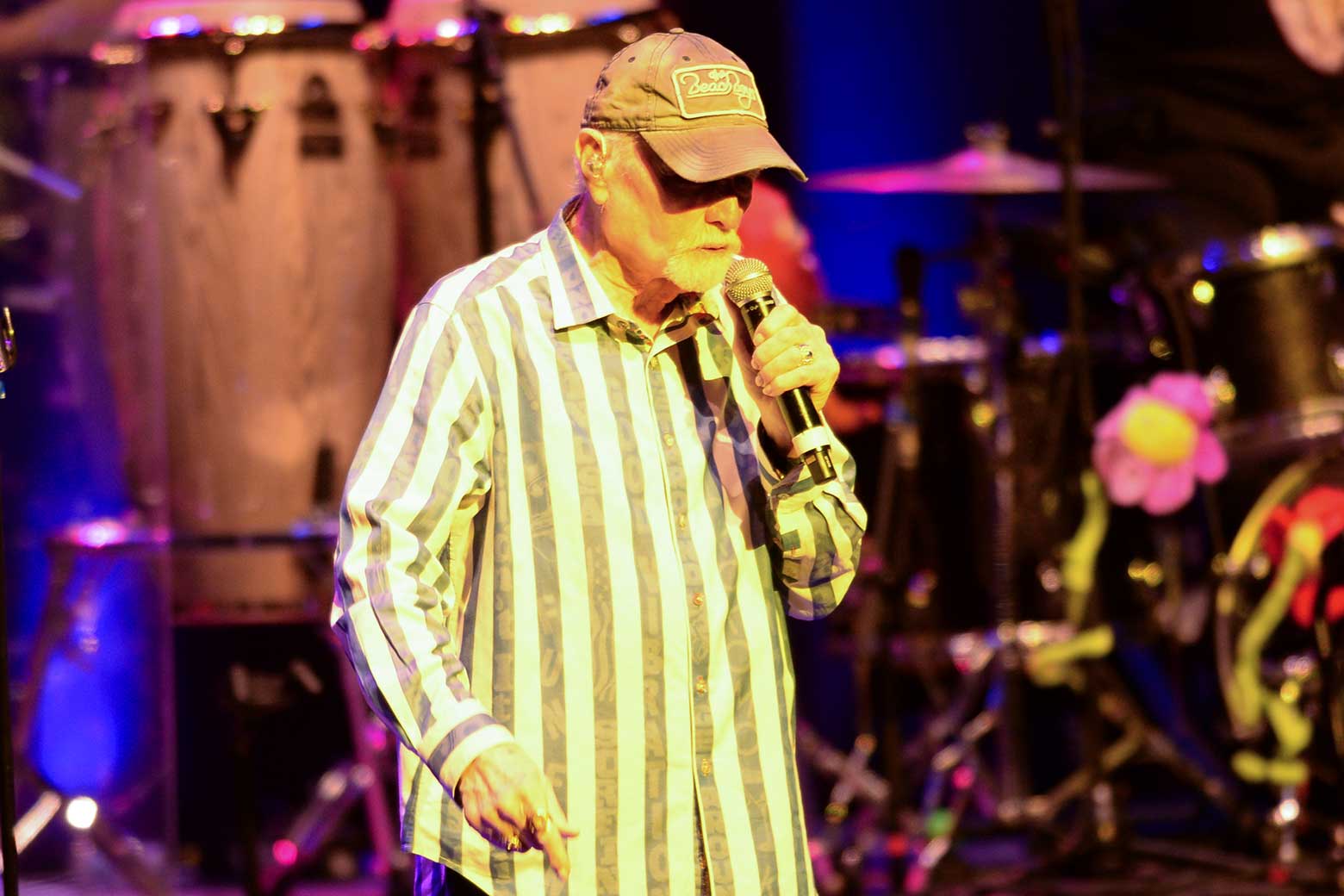
And so, with tricolored beach balls bouncing around the mezzanine, Love emerged onto the stage dressed in his usual pastel shirt and baseball cap, and shuffled gingerly to the microphone. A slideshow overhead displayed memories of happier days. We watched images of the Beach Boys in matching sailor-striped shirts posing for photos on rocky coastlines, of Brian Wilson’s shaggy coif bobbing over his head in the studio, of polyphonic harmonies shining like diamonds on muted, black-and-white soundstages. The musicians below were Beach Boys of a much more recent vintage than the ghosts above—drummer Jon Bolton has been playing with the band since 2023, vocalist Chris Cron joined earlier this year. In fact, outside of Love, the second-longest-tenured player is keyboardist Tim Bonhomme. He signed up in 1995.
The first song of the night was the minor 1968 hit “Do It Again”—a track written to resuscitate the band’s breezy sun-worshipping image after several challenging years. Love looked sallow and enfeebled; legs stiff, arms flat by his side. When he opened his mouth to sing, his once resonant tenor was reduced to a whisper, all warbled, strange, and barely there, decimated by the encumbering decades. My friend shot me an ashen look, the same one I remember him giving me during the opening salvo of the doomed Joe Biden debate.
“Is that Mark Love?” asked the woman next to me. She had malapropped his name, but with my help, she at least was now aware that she was in the presence of a Beach Boy.
I nodded in the affirmative. “Oh my god,” she said, looking almost stricken. “I feel bad for him.”
You would think that any show the Beach Boys play at the late hour of 2026—where the band’s legacy threatens to be snuffed out for good—would be wreathed with elegy. But Mike Love has not been blessed with such a fate. The terminus of the Beach Boys is here, and the mood is indifference. Worse than that, it’s obliviousness—nobody even knows the era is ending. Love soldiers onward, undeterred, running out the clock in the same ignoble venues he’s been playing for eons. The evening before this night in New Brunswick, the band played the Hard Rock Hotel & Casino in Atlantic City. Weeks earlier, the Beach Boys had been one of the featured acts at the Tampa Bay–area Busch Gardens Food & Wine Festival. (Other headliners included Skillet, Hoobastank, and Ryan Cabrera.)
I suppose this is what happens when you strike a deal with the devil—the bill eventually comes due. Love can only die happy if he dies onstage—maybe during the chorus of “Help Me, Rhonda”—and he’s hellbent on taking the Beach Boys with him. It’s a destiny he has meticulously arranged the circumstance for with deep-seated insecurity, indefatigable litigiousness, and a useful habit of outliving his bandmates. And now, Love’s denouement is finally at hand. To nobody’s surprise, it’s ending poorly.
Mike Love joined the Beach Boys at the group’s inception in 1961. He served as the nominal frontman, though all five members of the band occasionally sang lead. Love possessed a corny, sock-hop vocal presence and a winningly raffish three-margarita swagger, but the mythology of the Beach Boys centers almost exclusively on Brian Wilson; he of the celestial melodies, squirrely demeanor, and a vividly tortured inner life. Everyone else was always going to be a side character, and that has a way of fracturing rock bands.
Historians of the Beach Boys—and really, fans of 1960s pop music in general—know the tale from here. Love developed a reputation for being rapacious and pigheaded, colloquially understood to be driven by professional jealousy, which, especially in contrast to Wilson’s forlorn tenderness, made him one of the iconic antagonists of the baby boomer culture canon. “He’s considered one of the biggest assholes in the history of rock and roll,” proclaimed a 2016 Rolling Stone profile on Love, a charge he frequently disputed but had difficulty defending in the pages. His notoriety is buttressed by plenty of catty (and mostly apocryphal) quotes about the talent of other Beach Boys, and some wildly hotheaded flare-ups—including a memorably incoherent coronation speech at the 1988 Rock & Roll Hall of Fame, where Love attacked Mick Jagger for being “too chickenshit” to “get on stage with the Beach Boys.” (To this day nobody seems to know what Love was talking about. He blamed the incident on a lapse in his meditation schedule.)
Still, the particularities of Love’s disgruntlement are easy to parse, and they’ve come into sharper focus toward the end of his life. Love had the spectacular fortune of being in the Beach Boys, but he never resolved the gnawing feeling in his stomach that his importance to the group’s grandeur went unrecognized. Even more pathetically, Love wasn’t able to convince the world that we had all missed out on the fruits of his genius—that some great injustice had been unfairly committed, and the ledger was in desperate need of correction. This is why he has told the story of how he was the one to write the words to “Good Vibrations” approximately one billion times, or why he marketed his 2016 memoir as a riposte against the “many inaccuracies that have been said about me over the years,” or why, after Wilson’s funeral in 2025, Jardine accused Love of “serious megalomania,” saying that he wielded his eulogy to herald his own accomplishments. (“I didn’t feel the compassion,” Jardine said. “Let’s put it that way.”) Love fought long and hard to be a sympathetic figure, but unfortunately for him, nobody else agreed. It is the defining resentment of Love’s life, and for my money, that’s how he has found himself onstage, in his mid-80s, forcing his depleted voice through the chorus of “Barbara Ann.”
Love tried over and over again to get us to see things from his perspective. And when he couldn’t win narratively, he tried to win legally. Love sued his fellow Beach Boys on many, many different occasions, all with the tacit goal of asserting his position in the band’s hierarchy. The first—and most justifiable—lawsuit was the one he filed against Brian Wilson in 1992 for songwriting credits he never received during the band’s commercial apex. Love is now attached to 15 of the 37 singles in the Beach Boys’ catalog that cracked the Top 40, which makes him, by any objective measure, one of the most successful pop songwriters of all time. But even then, Love never achieved the respect he thought he deserved. His contributions to those songs were mostly lyrical, and Beach Boys fans tend to ascribe the brilliance of “Good Vibrations” to Wilson’s mind-expanding composition, rather than, you know, “She’s giving me excitations.”
Six years later, shortly after the death of Carl Wilson in 1998, Love secured the exclusive license to tour under the Beach Boys name, a right he has defended with mendacious pedantry ever since. Love sued Al Jardine for the temerity of performing under such guises as “Al Jardine, Beach Boy.” (They settled out of court. Jardine now plays with “The Pet Sounds Band.”) He then sued Brian Wilson again in 2005, during the release of Wilson’s long-gestating solo album, Smile. Wilson had employed a promotional tactic where he distributed free Beach Boys compilation albums to subscribers of the Daily Mail. Love said this “shamelessly misappropriated” his “likeness” as well as the “Beach Boys trademark.” (The case was thrown out by a judge.)
Finally, in 2012, after the original Beach Boys lineup got back together for a 50th anniversary reunion tour, Love ran afoul of his bandmates one last time. After the conclusion of the tour, Love reformed his own incarnation of the band—without Wilson’s involvement. The music media, which at this point had become accustomed to Love’s vindictiveness, framed this as him “firing” Wilson from the Beach Boys, a characterization that Wilson did not dispute. The truth is more nuanced, but at that point, it no longer mattered. Mike Love’s legacy was secure: He was the biggest asshole in the history of rock and roll, and there wasn’t much he could do about it.
And so, like many other infamous cranks who are nonetheless desperate to be treasured by the public, Love eventually found refuge in the MAGA movement. His incarnation of the Beach Boys hosted a fundraiser for Donald Trump’s campaign in 2020, and they played a dedicatory concert at Mar-a-Lago shortly after the president’s victory in 2024. (Unsurprisingly, Wilson and Jardine disavowed the endorsement.) With Love’s hippie mien and penchant for Eastern spirituality, he never looked or sounded like an America First patriot—but those partisans, as they often do, were quick to embrace him anyway. Love was a guest of honor at the Conservative Political Action Conference in 2022, and ever the opportunist, he has slyly nudged the Beach Boys brand in a more nativist direction to fit the taste of the last fans he’ll ever make. This most recent tour is billed as a celebration of the 250th birthday of the United States. Its poster features two star-spangled surfboards superimposed on the Declaration of Independence.
The story I’ve just recounted here was told across half a century, meted out chapter by chapter through yellowed rock-magazine articles and soft-focus Kathie Lee Gifford interviews. Love has been a villain in that story for his entire adult life. But watching him onstage, at the precise moment the Beach Boys blink out of existence, you do get the sense that the controversy that defined his career has become oddly immaterial. The hatred of Mike Love has simmered into resignation. Nobody wants to make the effort anymore. The book is already closed. Because if you are one of the hardcore fans who retain a feverish appetite for the Beach Boys—if life is not complete without tasting the residual vapors of the Endless Summer, before it does, in fact, end for good—then he is willing to sanctify your night. In fact, he’s the only one left on the planet who can.
Case in point: The friend I brought along to New Brunswick is the biggest Beach Boys aesthete I know. He attended that 50th anniversary tour, and has fond memories of getting ripping drunk in the parking lot beforehand, blasting the one-and-only Dennis Wilson solo album from his car stereo at full volume; it’s a cult favorite among in-the-know aficionados. Unsurprisingly, this friend of mine holds an elemental distaste for Mike Love, hewn through the yeoman’s work of fandom, and had never seen his version of the group live before. But he also has a 1-year-old daughter at home, who he sings “Surfer Girl” to every night, and he’d like to return home with a video of Love’s rendition—as eternal proof of the remarkable fact that she was alive at the same time as the Beach Boys. In that sense, Love retains the only leverage he’s ever needed to keep himself around.
Halfway through the show, Mike Love announced that the band would be taking a quick intermission. It’s not hard to see why. Love burned off all of his energy during the band’s car songs—”409” through “Little Honda” in rapid succession—the thinness of his voice dissolving to nothing in the loping harmonies, and he’s visibly debilitated afterwards. Love took a seat to catch his breath while the band powered through the other early-’60s hits; “Surfin’ USA,” “Catch a Wave,” and “I Get Around.” They played a pleasing cover of “Why Do Fools Fall in Love” by Frankie Lymon, as well as an inexplicable cover of “Rockaway Beach” by the Ramones, and before long, everyone exited the stage. The crowd diffused into the lobby for $12 High Noons; one man in a quarter-zip waiting in the bathroom line queried Google Gemini about “creative clashes in The Beach Boys.” It’s clear that outside of the sullen 14-year-olds brought to this theater by domineering parents and grandparents, I’m the youngest person here by a considerable margin—which is saying something, because I just turned 35.
When the lights went back down, the projector screen was illuminated with valedictory clips of Brian Wilson. A song emanated from the PA: the schmaltzy and mostly forgotten ballad “Brian’s Back,” written by Love in 1978 and released much later on a compilation album. The lyrics are about how excited Love is to make music with Wilson again after a multiyear layoff. Naturally, it was recorded about a decade before he would sue him for the first time. We watched Brian through the years, the baby-faced wunderkind, the husky lost soul, the beloved, doddering old man. As the final chords simmered away, the screen faded into a memoriam for Wilson—1942 to 2025. The letters were scripted in Comic Sans.
The show was pockmarked with countless other uncanny moments. Sincerity has never been Love’s strong suit, and the twilight of the Beach Boys has not provoked any further reflection—performative or otherwise. The production value was noticeably chintzy, representative of the band’s machine efficiency, and the lowly station they’ve been reduced to as so many fans have moved on. No room has been made for reminiscence. The elephant in the room—that this performance was part of a final act—went ignored. Love barely even spoke to the crowd between songs. This was just another show, just like the thousands before.
So, instead of sentimentality, we were presented with a ton of campy lapses in taste—which has always been Love’s comfort zone. When the Beach Boys played “Kokomo,” the screen morphed into an advertisement for Club Kokomo Spirits, a distillery that makes canned cocktails founded by Love in 2022. (Its proprietary flavors include “Mystique,” “Excitation,” and, you guessed it, “Kokomojito.”) When the band played “California Girls,” we were greeted with stock videos of women in polka-dot bikinis—all conspicuously white-skinned. Lyrics to “Surfin’ Safari” flashed by in a limp attempt to rouse the crowd, who remained seated throughout the show, into a Sunday school–style singalong. They tried the same for “Little Deuce Coupe,” which was spelled incorrectly. (They forgot the E: “Little Deuce Coup.”) Sometimes the audience was greeted with resurrected footage of the Beach Boys in their rakish prime. There was Mike Love, serpentlike in tight spandex pants, high-kicking with sleazy panache while his entombed presence sang the same song below—a reminder to everyone in the building that what they were chasing had already disappeared.
And then, of course, Mike Love’s son Christian—who has played rhythm guitar in the Beach Boys since 2006—stepped up to his microphone, mustered his best affectation of Carl Wilson’s achingly pure voice, and sang “God Only Knows,” and time stopped, like it always does. Brian Wilson once said that recording Pet Sounds was akin to a spiritual experience—he could visualize halos hovering over the heads of his brothers, cousins, and friends in the studio. And I suppose it speaks to the mythic power of the material that all of these years later—through innumerable permutations of the group, when the romance of the music has been so sullied by internecine rock-and-roll feuds, when everyone is dead, no less—that the holiness survives, and even thrives. For a few transcendent minutes, I was, indeed, right there watching the Beach Boys, the tastelessness and cheesiness purged by the overwhelming divinity, a miracle of time and space.
Love wrapped up the show with “Fun, Fun, Fun,” which must be the zillionth time he’s played it live, and my friend and I made the long drive back to New York. In the weeks afterward, reports of Love’s impaired condition started to break containment. A TikTok featuring a shockingly zombified performance of “Kokomo” at the Atlantic City show went viral. When the band kicked off a run of dates in England a few weeks later, fans were scandalized by Love’s vacant condition. But the Beach Boys still have dozens more shows on the tour. They will soon play the Shooting Star Casino in Mahnomen, Minnesota, and the Indian Crossing Casino in Waupaca, Wisconsin. And just like Love, the diehards will be there until the bitter end.